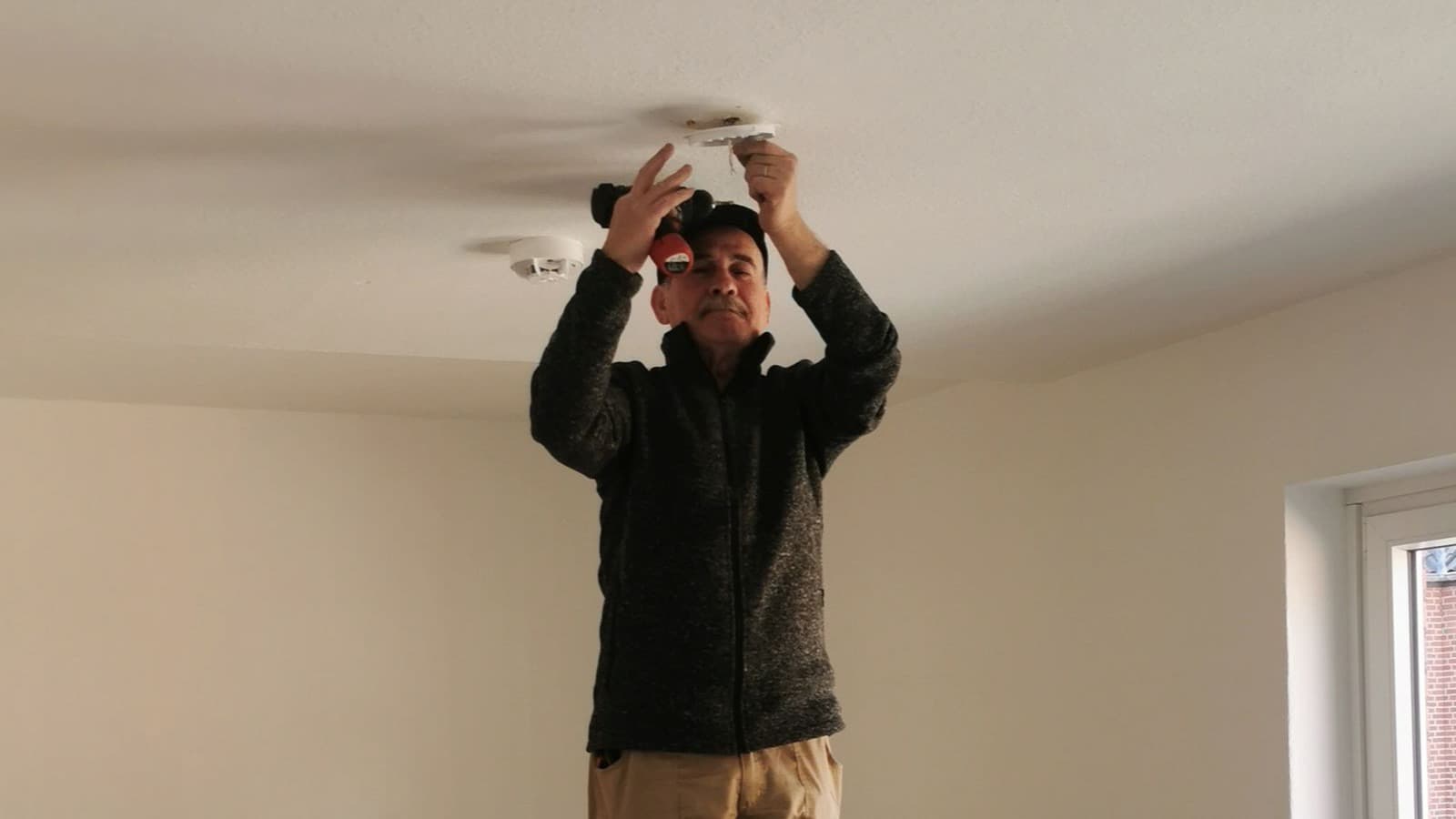
A home safety punch list for a Sacramento home comes down to 12 items, and a handyman can check every one of them and fix most of them in a single half-day visit for $650 to $1,500. The four that matter most are smoke and carbon monoxide alarms that are actually within their 10-year life, GFCI protection at every wet-area and garage receptacle, a graspable handrail on every stair, and grab bars anchored into something that holds 250 pounds. More than half of Sacramento County's housing stock was built before 1980, which predates nearly every one of those requirements -- so the odds that a typical Carmichael, Citrus Heights, or East Sacramento home passes all 12 without work are low. This 2026 guide walks the list item by item, with the California code behind each one, the pass standard a handyman should check against, and what each fix costs in the Sacramento metro.
Key Takeaways
- Half-day visit cost: $650 to $1,500 in Sacramento for the 12-point walkthrough plus the six to eight fixes a typical older home needs; $1,200 to $2,800 for a pre-1980 home that has never been brought current
- Smoke alarms: Replace at 10 years from the manufacture date printed on the back (NFPA 72); California requires sealed 10-year batteries on new battery-only units and an alarm in every bedroom, outside each sleeping area, and on every level
- CO alarms: Required in every California home with a gas appliance, fireplace, or attached garage since July 2011 (Health and Safety Code 17926); 5-to-10-year sensor life
- GFCIs: Test monthly; replace at 10 to 15 years or whenever the test button no longer trips; any receptacle in a kitchen, bathroom, garage, laundry, or outdoors without one is a gap
- Handrails and grab bars: Rail on any stair with 4+ risers, 34 to 38 inches above the nosings; grab bars anchored to studs, blocking, or a 250-pound-rated anchor -- never drywall alone
- Handyman scope in California: Rails, bars, alarms, strapping, and like-for-like GFCI swaps fit a handyman visit; new circuits, breakers, and panel work need a C-10 electrician and a permit
Most Sacramento homeowners call a handyman for a leaking faucet or a sticking door. The safety items rarely make the list because nothing is visibly broken -- the smoke alarm still chirps when you press the button, the bathroom outlet still charges a phone, the stairs still work. The problem is that every one of those items has a failure mode that is invisible until the day it matters. A 12-year-old smoke alarm beeps on test and still misses a smoldering fire because the sensing chamber has degraded. A 1998 GFCI passes power fine and does not trip on a ground fault because the electronics failed silently. A stair rail that was screwed into drywall in 2006 holds until someone actually falls against it.
Sacramento's housing stock makes this walkthrough more relevant than it would be in a newer market. The median Sacramento County home was built around 1980 per U.S. Census American Community Survey data -- before bathroom and garage GFCIs were universal, before bedroom smoke alarms were code, three decades before California required carbon monoxide alarms, and long before anyone strapped a water heater. Every requirement in this guide was added by code over the past 50 years, and existing homes were never forced to catch up unless a permit was pulled. The list below is how you catch up on purpose.
What Safety Items Should a Handyman Check? The 12-Point Sacramento Punch List
Here is the full list in the order a ProFlow technician walks it -- top of the house down, and life-safety before convenience. Each row gives the pass standard we check against and the installed cost in the Sacramento metro for 2026 if the item fails. Prices hold within 5 to 8 percent across Sacramento, Roseville, Rocklin, Citrus Heights, Carmichael, Elk Grove, and Folsom.
| Item | Pass standard | Sacramento fix cost (installed) |
|---|---|---|
| 1. Smoke alarms | One in each bedroom, outside each sleeping area, on every level; under 10 years from manufacture date; sealed 10-year battery or hardwired with backup | $75-$150 each; $350-$700 for a 3-to-5-unit wireless-interconnect set |
| 2. CO alarms | Outside each sleeping area and on every level; under the sensor end-of-life date | $60-$120 each; $110-$200 for a hardwired combo smoke/CO unit |
| 3. GFCI receptacles | Present at every kitchen counter, bathroom, garage, laundry, outdoor, and within-6-ft-of-sink receptacle; trips and resets on test | $120-$225 first outlet; $75-$125 each additional in the same visit |
| 4. Stair handrails | Any stair with 4+ risers; 34-38 in. above nosings; graspable; ends return to wall or post; no movement under body weight | $275-$650 interior; $450-$1,400 exterior porch or step rail |
| 5. Guards on decks and landings | Required where the walking surface is more than 30 in. above grade; 42 in. minimum height; balusters that reject a 4-in. sphere; no rot at posts | $300-$900 per repaired section |
| 6. Grab bars | In showers, tubs, and beside toilets for anyone with fall risk; anchored to studs, blocking, or a 250-lb-rated anchor | $125-$275 each; add $150-$300 for blocking behind tile |
| 7. Water heater strapping | Two straps in the upper and lower thirds, anchored to studs, flexible gas and water connectors (HSC 19211) | $110-$250 |
| 8. Furniture and TV anchors | Every dresser, bookcase, and flat-screen over 30 in. tall anchored to a stud | $40-$75 per piece; $175-$275 for a 5-piece bundle |
| 9. Dryer vent | Rigid or semi-rigid metal duct, no foil, cleaned within the past 12 months, exterior flap opens freely | $120-$220 cleaning; $180-$400 to replace foil duct with metal |
| 10. Garage door safety | Auto-reverse trips on a 2x4 laid flat; photo-eyes within 6 in. of the floor and aligned; manual release reachable | $95-$180 adjust and realign; $450-$800 opener replacement |
| 11. Fire extinguisher | 2A:10B:C rated, mounted near the kitchen exit, gauge in the green, under 12 years old | $75-$135 including unit and mount |
| 12. Bedroom egress | Every bedroom window opens freely; quick-release on any security bars; painted-shut sashes freed; exterior house numbers visible from the street (4 in. minimum) | $85-$200 per window; $60-$140 for house numbers |
Sacramento Home Safety Punch List: Installed Cost by Item (2026)
Installed pricing from ProFlow Home Services handyman safety visits across the Sacramento metro, Q3 2025 through Q3 2026, including materials. Bundled half-day visits covering six to eight of these items typically total $650 to $1,500 because mobilization and ladder setup are shared across every fix.
Why the Build Year of Your Sacramento Home Predicts What Is Missing
Every item on the punch list entered the building code in a specific year, and existing homes were grandfathered. That means the build year of a Sacramento home is a reliable predictor of which safety items were never installed. A 1965 Arden-Arcade ranch had no GFCI requirement anywhere. A 1978 Citrus Heights tract home got GFCIs in the bathroom and garage but not the kitchen. A 1995 Elk Grove home has kitchen GFCIs but may have no CO alarm and no tamper-resistant receptacles. Even a 2012 Roseville house predates the sealed 10-year smoke alarm battery rule.
When Each Safety Requirement Entered the Code (Homes Built Before Each Year Likely Lack It)
Sources: National Electrical Code Article 210.8 adoption history (GFCI), UL 943 (self-test GFCI, 2015), California Health and Safety Code Sections 13114 (sealed battery), 17926 (CO alarms), and 19211 (water heater bracing), and 16 CFR 1211 (garage door openers, 1993). Median build year from U.S. Census American Community Survey 5-year estimates for Sacramento County. Existing homes were not required to retrofit unless permitted work triggered it.
The practical read on this chart: if your Sacramento home was built before 1996 and has never had a kitchen or bathroom remodel with a permit, assume the GFCI coverage is incomplete. If it was built before 2011 and nobody added a CO alarm on their own, there is none. If the smoke alarms were installed before 2015, they are on borrowed time regardless of how they test. The first-year punchlist for older Sacramento homes covers the broader multi-trade picture for East Sac, Land Park, and Curtis Park buyers; this guide is the life-safety subset.
Step 1: Smoke Detectors -- Test, Date, and Bring Up to California Code
Smoke alarms are the single highest-return item on the list, and the most commonly neglected. NFPA's most recent Smoke Alarms in U.S. Home Fires report found that nearly three out of five home fire deaths happened in homes with no smoke alarms (41 percent) or alarms that failed to operate (16 percent), and that the death rate per 1,000 reported home fires was 55 percent lower in homes with working alarms. The leading reason alarms failed was missing, disconnected, or dead batteries -- which is exactly what California's sealed-battery rule was written to fix.
U.S. Home Fire Deaths by Smoke Alarm Status
Source: NFPA, Smoke Alarms in U.S. Home Fires (Ahrens), based on U.S. Fire Administration NFIRS and NFPA survey data. Percentages are of home fire deaths.
How Often Should You Replace Smoke Detectors?
Every 10 years from the date of manufacture, per NFPA 72 and the alarm manufacturers themselves. The date is printed on the back of the unit -- California Health and Safety Code Section 13114 has required a visible manufacture date, a place to write the install date, and a hush button on every alarm sold in the state since January 1, 2015. Twist the alarm off its base and read it. If there is no date, the alarm predates 2015 and is due. Between replacements, test monthly with the button and replace batteries yearly on any unit that still takes a replaceable one.
The test button only confirms the horn and the circuit work. It does not confirm the sensing chamber can still detect smoke, which is why NFPA sets a hard 10-year limit regardless of test results. On ProFlow walkthroughs across Carmichael, Fair Oaks, and Citrus Heights, roughly one in three homes has at least one alarm dated before 2012, and most homeowners are surprised because every one of them still chirps on test.
Where California Requires Smoke Alarms
The California Residential Code (Section R314) and Health and Safety Code Section 13113.7 require a smoke alarm in each bedroom, in the hallway outside each separate sleeping area, and on every level of the home including basements. Mount them on the ceiling at least 4 inches from any wall, or on the wall 4 to 12 inches down from the ceiling. Keep them at least 10 feet from a cooking appliance to limit nuisance alarms, and out of the direct airflow of HVAC supply registers.
- Battery-only units: Any battery-operated smoke alarm sold in California since July 1, 2014 must have a non-removable, non-replaceable 10-year sealed battery (HSC 13114). Replace the whole unit at 10 years or at the end-of-life chirp.
- Hardwired units: Homes built or remodeled with a permit since the early 1990s usually have hardwired, interconnected alarms with battery backup. Swap them for the same model family so the interconnect keeps working; a mismatched brand on an interconnect wire is a common cause of phantom alarms.
- Older homes without wiring: Battery alarms are acceptable where no hardwiring exists. For interconnection without running wire, wireless-interconnect battery alarms (Kidde and First Alert both make them) let a garage or hallway alarm trigger the bedroom units -- $350 to $700 installed for a 3-to-5-unit set.
- Permit trigger: Any permitted alteration, repair, or addition brings the whole home's smoke alarm coverage up to the current standard (CRC R314.2.2). Hardwiring is not required if no interior wall or ceiling finish is being removed.
Photoelectric vs Ionization in a Sacramento Home
Ionization alarms respond faster to fast-flaming fires; photoelectric alarms respond faster to smoldering fires and are far less prone to nuisance trips from cooking and, in Sacramento, from wildfire smoke drifting in during Sierra fire season. NFPA recommends both technologies or dual-sensor units. The practical ProFlow spec for a Sacramento home: photoelectric or dual-sensor sealed 10-year units in bedrooms and hallways, and a photoelectric unit near the kitchen. During heavy smoke days, do not pull batteries or cover alarms -- the wildfire smoke and ash cleanup guide covers the HVAC filter reset that keeps indoor particulate low enough that alarms stop tripping.
Smoke Detector Installation by a Handyman in Sacramento
A handyman replaces a battery or sealed alarm in about 10 minutes and a hardwired unit in 15 to 25 minutes, including the interconnect harness. Installed cost in the Sacramento metro runs $75 to $150 per sealed unit and $95 to $180 per hardwired unit, including the alarm. Bundling all alarms in the home into one visit -- the typical 3-bedroom Sacramento home needs five -- brings the per-unit price to the low end because the ladder is already set up. The American Red Cross Home Fire Campaign also installs free 10-year alarms in the Sacramento region for households that qualify, which is worth checking for elderly relatives or a rental portfolio.
Step 2: Carbon Monoxide Alarms -- Required in Nearly Every Sacramento Home Since 2011
California's Carbon Monoxide Poisoning Prevention Act of 2010 (Health and Safety Code Section 17926) required a CO alarm in every existing single-family home with a fuel-burning appliance, a fireplace, or an attached garage by July 1, 2011, and in every other dwelling unit by January 1, 2013. In Sacramento County that is nearly every house -- gas furnaces, gas water heaters, gas ranges, and attached garages are standard across the metro. Yet on walkthroughs of pre-2011 homes that have not changed hands since, ProFlow technicians find no CO alarm at all in roughly one home out of four.
Placement mirrors smoke alarms: outside each sleeping area and on every level, including any basement. Plug-in or battery units are acceptable in existing homes; hardwired combination smoke/CO units are the cleanest option where a hardwired smoke alarm already exists. The CO sensor has a finite chemical life -- 5 to 10 years depending on the model -- and the unit chirps a distinct end-of-life pattern when it expires. Sacramento winters push furnace and fireplace use into the hours everyone is asleep, which is exactly when a failed sensor matters. Installed cost: $60 to $120 per battery or plug-in unit, $110 to $200 for a hardwired combo.
Step 3: GFCI Outlet Replacement -- Where Sacramento Homes Are Still Unprotected
A ground-fault circuit interrupter cuts power in roughly 1/40th of a second when it detects current leaking to ground -- through water, a damaged cord, or a person. The Electrical Safety Foundation International estimates GFCIs could prevent roughly two-thirds of the approximately 300 electrocutions that happen in and around U.S. homes each year. The National Electrical Code, which California adopts as the California Electrical Code, has added GFCI locations steadily since 1971, and older Sacramento homes reflect whichever year the last permitted remodel happened.
Where GFCI Protection Is Required
- Bathrooms: Every receptacle
- Kitchens: Every receptacle serving a countertop, plus any receptacle within 6 feet of the sink edge, including dishwasher and disposal outlets under current code
- Garages and accessory buildings: Every 125-volt receptacle, including the ones behind the freezer and workbench
- Outdoors: Every receptacle, with an in-use weatherproof cover
- Laundry areas: Every receptacle, plus anything within 6 feet of a utility sink
- Crawl spaces and unfinished basements: Every receptacle
- Since the 2020 NEC: 250-volt receptacles for dryers and ranges in the areas above, in new work
Existing homes do not have to add these unless a permit triggers it, but the retrofit is cheap and there are two ways to get it. A GFCI receptacle protects itself and every outlet downstream on the same circuit (wired through the LOAD terminals), so one GFCI at the first bathroom outlet often covers both bathrooms in a 1970s Sacramento floor plan. A GFCI breaker in the panel protects the entire circuit but is a C-10 electrician job, not a handyman job.
How to Test a GFCI and When to Replace It
Press TEST monthly. Power to the outlet -- and anything downstream -- should cut immediately; press RESET to restore it. If TEST does not trip the outlet, or RESET will not hold, the GFCI has failed and needs replacement the same week. Since June 2015, UL 943 has required every new GFCI receptacle to self-test continuously and either deny power or signal (a red light or beep) when its protection has failed. Any GFCI installed before 2015 has no such safeguard, which is why older units can keep passing power for years after the protection circuit dies. Plan on replacement at 10 to 15 years, sooner in a Sacramento garage where 105-degree summer heat and winter damp degrade the electronics faster than a climate-controlled bathroom does.
Can a Handyman Install GFCI Outlets in California?
A like-for-like receptacle swap -- pulling an existing outlet from its box and installing a GFCI in the same box on the same circuit -- is the standard handyman scope, and most Sacramento-area building departments treat it as minor repair that does not require a permit. Two rules apply. First, under Business and Professions Code Section 7048, an unlicensed handyman is limited to jobs under $1,000 combined labor and materials that need no permit; the threshold rose from $500 on January 1, 2025. Second, anything beyond the swap -- a new circuit, extended wiring, a GFCI breaker, aluminum-wire remediation, or any panel work -- needs a C-10 licensed electrician and a permit. The Sacramento building permits guide covers which electrical work crosses that line.
ProFlow operates as a licensed and insured contractor with electrician, carpentry, and general repair on the same crew, which is what lets the GFCI swaps ride along with the rails, bars, and alarms in a single visit. Installed cost in Sacramento: $120 to $225 for the first outlet and $75 to $125 for each additional outlet in the same visit. Two things push it higher: a shallow 1960s box that needs a box extender to fit the deeper GFCI body ($25 to $45 extra), and ungrounded two-wire circuits in pre-1965 homes, where the GFCI is still legal and still protects people but must carry a "No Equipment Ground" label. For the broader question of which electrical and repair tasks are worth doing yourself, see DIY vs pro home repairs in Sacramento.
Step 4: Handrails, Guards, and Grab Bars -- The Fall-Prevention Items
Falls are the leading cause of injury death for adults 65 and older in the United States. CDC data show one in four older adults falls each year, falls send roughly 3 million older adults to emergency departments annually, and more than 38,000 adults 65 and older died from falls in 2021. Stairs and bathrooms are where the majority of home falls happen, and both are handyman-fixable in an afternoon.
Stair Handrail Standards a Handyman Checks Against
The California Residential Code (Section R311.7.8) requires a handrail on at least one side of any stairway with four or more risers. The rail sits 34 to 38 inches above the stair nosings, runs continuously from the top riser to the bottom riser, has a graspable profile (a round rail 1-1/4 to 2 inches in diameter, or an equivalent shaped profile), clears the wall by at least 1-1/2 inches, and returns to the wall or terminates at a newel post so a sleeve or purse strap cannot catch on the open end. The ProFlow check is simpler than the code: lean your full weight on the rail at the top, middle, and bottom. Any movement means the brackets are in drywall, not studs, and the rail needs to be re-anchored.
Guards are the other half. Anywhere a deck, landing, porch, or balcony surface sits more than 30 inches above the ground below, the code requires a 42-inch guard with balusters spaced so a 4-inch sphere cannot pass. On Sacramento decks built in the 1980s and 1990s, the failure point is almost always rot at the post base or a rusted-through ledger bolt, not the rail itself. The deck, railing, and patio cover restoration guide covers the full outdoor scope; on the safety punch list, the handyman is checking that every guard post is solid and every rail resists a hard shove.
Grab Bar and Handrail Install: Anchoring Is Everything
A grab bar needs to hold 250 pounds of sudden load -- the ADA design standard, and roughly what an adult puts on a bar when a foot slips in a tub. That means both flanges land on studs or on solid blocking behind the wall, or the installer uses a hollow-wall anchor rated for the load (WingIts and Moen SecureMount are the two ProFlow crews carry) where tile and stud spacing make stud hits impossible. Towel bars are not grab bars, and a grab bar screwed into drywall with plastic anchors is worse than no bar at all because it invites someone to trust it.
- Tub or shower, horizontal: 33 to 36 inches above the finished floor along the back wall; 24-inch bar minimum
- Shower entry, vertical: Bottom of the bar 38 to 48 inches above the floor at the entry side
- Beside the toilet: 42-inch bar minimum on the side wall, 33 to 36 inches above the floor, centered 12 inches from the rear wall
- Exterior steps and entries: A single graspable rail on any entry with two or more steps, anchored to the house framing or a set post -- Sacramento porches are where most winter-rain slip falls happen
Installed cost in Sacramento: $125 to $275 per grab bar including the bar, $150 to $300 more per location if tile has to be opened to add blocking, and $275 to $650 for an interior stair handrail. For homeowners planning ahead for a parent or a long-term stay, the aging-in-place modifications guide for Sacramento goes deeper on lighting, thresholds, and bathroom layouts. The safety punch list stops at the bars and rails that every home should have regardless of age.
Step 5: The Quick Handyman Fixes That Round Out the List
The remaining seven items each take 15 to 45 minutes and rarely cost more than $250. They are where a bundled visit earns its keep -- none of them justifies a service call on its own, and all of them get skipped for years as a result.
Water Heater Seismic Strapping
California Health and Safety Code Section 19211 requires every residential water heater to be braced, anchored, or strapped against earthquake motion, and the seller of any home certifies compliance at transfer. The correct install is two heavy-gauge straps -- one in the upper third of the tank, one in the lower third, at least 4 inches above the controls -- lagged into studs, with flexible connectors on the gas and water lines. Sacramento sits far enough from the major faults that homeowners tend to skip this, but the strapping also protects the gas line from a tank that gets bumped in a garage. A handyman does it in 30 minutes for $110 to $250.
Furniture and TV Anti-Tip Anchors
CPSC tip-over reports count roughly 20,000 emergency-room-treated injuries a year from falling furniture, TVs, and appliances, most involving children under six. Every dresser, bookcase, and freestanding flat-screen over 30 inches tall gets a strap or bracket into a stud. Anchor kits are $10 to $20; the handyman cost is in finding studs behind the piece and drilling through the back of laminate furniture without splitting it. $40 to $75 per piece, $175 to $275 for five.
Dryer Vent Cleaning and Duct Replacement
The U.S. Fire Administration counts about 2,900 home clothes dryer fires a year, and failure to clean the vent is the leading factor at 34 percent. The check: pull the dryer, confirm the duct is rigid or semi-rigid metal (white vinyl and thin foil ducts trap lint and are no longer code), clean it end to end, and confirm the exterior flap opens with the dryer running. Sacramento's cottonwood and sycamore fluff seasons also clog exterior hoods from the outside. Cleaning runs $120 to $220; replacing a foil duct with metal, $180 to $400 depending on run length.
Garage Door Auto-Reverse and Photo-Eyes
Every opener sold since 1993 must reverse on contact and have photo-eye sensors within 6 inches of the floor (16 CFR 1211). Test both: lay a 2x4 flat under the door and close it -- the door must reverse within 2 seconds of touching the board -- then wave a broom through the sensor beam mid-close. If either test fails, the opener force setting or the sensor alignment needs adjustment, $95 to $180. If the opener predates 1993, it has no photo-eyes and should be replaced, $450 to $800 installed.
Fire Extinguisher, Bedroom Egress, and House Numbers
A 2A:10B:C extinguisher mounted on the wall near the kitchen exit -- not under the sink where a stove fire blocks it -- covers the vast majority of home fire starts. Check the gauge yearly; disposable units are replaced at 12 years. Every bedroom window must open freely from inside without tools; painted-shut sashes and swollen frames are common in Land Park and Oak Park bungalows and get freed and lubricated for $85 to $200 per window. Any security bars on bedroom windows need an interior quick-release, which the California Transfer Disclosure Statement asks about specifically. Finally, house numbers at least 4 inches tall in a contrasting color, visible from the street, so a Sacramento Metro Fire or Sacramento Fire engine does not lose 60 seconds finding the address.
Replacement and Service Intervals for Home Safety Items
Intervals from NFPA 72 (smoke alarms), manufacturer end-of-life specifications (CO alarms and GFCIs), NFPA 10 (portable extinguishers), and U.S. Fire Administration guidance (dryer vents). Shaded bands show the manufacturer range. Replace any item earlier if it fails a monthly test.
The Half-Day Handyman Safety Visit: How It Runs and What It Costs
The reason to do this as one visit instead of twelve is straightforward: mobilization, ladder setup, and stud-finding are shared, and a technician who walks the whole house catches the item you did not know to ask about. The 12-point table above is the home safety checklist a handyman actually works from; here is the sequence a ProFlow crew runs it in on a typical Sacramento home.
- Walkthrough and date check (30 minutes). Every alarm comes off its base and gets dated. Every GFCI gets a TEST/RESET cycle. Every rail gets a load test. The water heater, dryer duct, garage door, and extinguisher get a look. You get a punch list with pass/fail and a flat price per fix before any work starts.
- Alarms (45 to 60 minutes). Replace expired smoke alarms, add missing bedroom and CO units, pair any wireless interconnect set.
- GFCIs (15 to 20 minutes per outlet). Swap the first outlet on each wet-area circuit, confirm downstream protection with a plug-in tester, label "GFCI Protected" on covered outlets.
- Rails and bars (30 to 90 minutes). Re-anchor or replace stair rails, install grab bars, add an exterior step rail if needed.
- Quick fixes (60 to 90 minutes). Strap the water heater, anchor furniture and TVs, clean the dryer vent, test and adjust the garage door, mount the extinguisher, free painted-shut windows, install house numbers.
- Documentation. Before-and-after photos and the pass/fail list land in ProFlow360, which doubles as the compliance record a seller or landlord needs later.
A Carmichael example. A 1968 ranch on a quarter-acre lot near Arden-Carmichael: four ionization alarms dated 2004, no CO alarm, no GFCI in either bathroom, one GFCI in the garage that would not trip, a loose stair rail to a sunken living room, an unstrapped water heater, and a foil dryer duct. Five sealed dual-sensor alarms, two CO alarms, three GFCI swaps, a re-anchored rail, two straps, and a metal duct came to $1,180 and took a technician just under four hours. The Carmichael home maintenance guide covers why that housing stock needs this walkthrough more than most.
A Roseville rental turnover. A landlord with a 2001 house between tenants: alarms all dated 2009, no CO alarm on the second floor, two grab bars requested by the incoming tenant, and a wobbly exterior step rail. $740, done during the paint crew's dry time. California Health and Safety Code Section 13113.7 makes the owner responsible for working smoke alarms at the start of every tenancy, and Section 17926 does the same for CO alarms, so this is a line item on every Sacramento rental turnover package, not an optional extra.
When to Call an Electrician or Pull a Permit Instead
A handyman safety visit covers everything above, and knowing where it stops is part of the value. Call a C-10 electrician, and expect a permit, for any of the following:
- GFCI or AFCI breakers in the panel, or any panel work at all
- New circuits or extended wiring to add a receptacle where none exists -- common when a 1960s kitchen has one counter outlet
- Aluminum branch wiring (roughly 1965 to 1973 construction, found in parts of Rancho Cordova, Citrus Heights, and Carmichael) -- receptacle swaps on aluminum need CO/ALR-rated devices or AlumiConn connectors, and the whole system deserves an electrician's assessment
- Federal Pacific or Zinsco panels -- if the walkthrough finds one, the punch list stops and the panel becomes the priority
- Hardwiring smoke alarms into a home that has none, which means running new cable through finished walls and ceilings
Any contractor doing that work should be verifiable at the CSLB license lookup, carry workers' compensation, and pull the permit under their own license rather than asking you to pull it as an owner-builder. The contractor hiring guide for Sacramento walks the vetting checklist.
Sacramento-Specific Notes: Selling, Renting, and Older Neighborhoods
Three situations turn this punch list from good practice into a requirement in Sacramento.
- Selling a home. California requires the water heater strap certification (HSC 19211) and the smoke alarm compliance statement (HSC 13113.8) at transfer, and the Transfer Disclosure Statement asks about CO alarms and security-bar releases. Buyer inspectors in Sacramento flag missing GFCIs and loose rails on nearly every pre-1990 home, and each one becomes a repair request. Handling the list before photos is cheaper than negotiating it during the contingency -- the what to fix before selling in Sacramento guide puts it in the context of the full pre-listing scope.
- Renting a home. Owners are responsible for working smoke and CO alarms at the start of each tenancy and for repair when a tenant reports a problem. Deck guards and stair rails fall under the implied warranty of habitability. Document every fix with dated photos.
- Buying or inheriting an older home. Land Park, Curtis Park, East Sacramento, Oak Park, Carmichael, Fair Oaks, and the older sections of Citrus Heights and Rancho Cordova carry the highest odds of missing three or more items on the list. Run the walkthrough in the first 30 days, alongside the new Sacramento homeowner checklist. For inherited homes headed to sale, the estate cleanout and repair guide shows where the safety items sit in the 12-week plan.
For homeowners staying put, the safety items fold into the annual cycle: alarm test and battery swap when the clocks change, GFCI test monthly, dryer vent and garage door test every fall, and the full 12-point walkthrough every three to five years or whenever a household member's mobility changes. The 12-month Sacramento home maintenance calendar slots each of these against the rest of the year's gutter, paint, and drainage work, and a ProFlow maintenance plan can carry the alarm and GFCI tests on a standing schedule.
What ProFlow Brings to a Home Safety Punch List
ProFlow Home Services runs the 12-point walkthrough as a single flat-priced handyman visit across Sacramento, Roseville, Rocklin, Citrus Heights, Carmichael, Elk Grove, Folsom, and the surrounding metro. Because the crew carries electrical, carpentry, and general repair together, the GFCI swaps, the grab bars, the alarms, and the water heater straps all happen on the same ticket -- no second contractor, no second mobilization fee. Every item gets a before-and-after photo in ProFlow360, which is the documentation a seller hands to escrow and a landlord keeps on file. For the older housing stock in Citrus Heights and Roseville, the walkthrough is the first thing we recommend on any new-customer visit. The handyman services guide for Sacramento covers everything else that fits on the same truck.
Frequently Asked Questions
What safety items should a handyman check on a home walkthrough?
A complete home safety punch list covers 12 items: smoke alarms in every bedroom, outside each sleeping area, and on every level; carbon monoxide alarms outside sleeping areas and on each floor; GFCI protection at every kitchen, bathroom, garage, laundry, and outdoor receptacle; a graspable handrail on any stair with four or more risers; guards on decks and landings more than 30 inches above grade; grab bars anchored to studs or blocking in any bathroom used by someone with fall risk; two seismic straps on the water heater; anti-tip anchors on dressers, bookcases, and TVs; a clean dryer vent; a working garage door auto-reverse and photo-eye; a mounted 2A:10B:C fire extinguisher in the kitchen; and bedroom windows that open freely with quick-release hardware on any security bars. On a typical Sacramento home, a handyman can inspect all 12 and fix most of them in a single half-day visit.
How often should you replace smoke detectors?
Replace every smoke alarm 10 years after its date of manufacture, not its install date -- the date is printed on the back of the unit per California Health and Safety Code Section 13114. Test each alarm monthly with the test button and replace the battery once a year on any alarm that still takes a replaceable 9-volt or AA battery. Alarms sold in California since July 1, 2014 must use a sealed 10-year battery, so those units get replaced as a whole when they chirp end-of-life or hit the 10-year mark, whichever comes first. If any alarm in a Sacramento home is yellowed, has no visible date, or dates from before 2015, replace it now -- NFPA 72 sets the 10-year ceiling because the sensing chamber degrades even when the test button still beeps.
Can a handyman install grab bars and GFCI outlets in California?
Yes, with limits. Grab bars and handrails are carpentry: any handyman can install them, and the only thing that matters is anchoring into studs, blocking, or a rated hollow-wall anchor that holds 250 pounds. GFCI outlets are electrical: in California, an unlicensed handyman can only take jobs under $1,000 in combined labor and materials that do not require a building permit (Business and Professions Code Section 7048, threshold raised from $500 to $1,000 on January 1, 2025). A like-for-like swap of an existing receptacle for a GFCI in the same box is generally treated as minor repair by Sacramento-area building departments and falls inside that scope. Adding a new circuit, extending wiring, replacing a breaker, or any panel work needs a C-10 licensed electrician and usually a permit. ProFlow Home Services is a licensed and insured contractor with electrical, carpentry, and general repair under one roof, which is why the whole punch list -- bars, rails, alarms, and receptacle swaps -- fits into one visit.
How much does a home safety punch list cost in Sacramento?
A half-day handyman safety visit in the Sacramento metro runs $650 to $1,500 in 2026 for the walkthrough plus the typical six to eight fixes an older home needs. Per-item pricing installed: sealed 10-year smoke alarms $75 to $150 each, carbon monoxide alarms $60 to $120 each, GFCI receptacle swaps $120 to $225 for the first and $75 to $125 for each additional outlet in the same visit, grab bars $125 to $275 each, an interior stair handrail $275 to $650, water heater seismic strapping $110 to $250, furniture and TV anti-tip anchors $40 to $75 per piece, and dryer vent cleaning $120 to $220. A pre-1980 Sacramento, Carmichael, or Citrus Heights home that has never been brought up to current alarm and GFCI standards typically lands at $1,200 to $2,800 for the full list.
Does California require carbon monoxide alarms in single-family homes?
Yes. The Carbon Monoxide Poisoning Prevention Act of 2010 (Health and Safety Code Section 17926) has required a carbon monoxide alarm in every existing single-family home that has a fuel-burning appliance, a fireplace, or an attached garage since July 1, 2011, and in all other dwelling units since January 1, 2013. That covers nearly every home in Sacramento County -- gas furnaces, gas water heaters, gas ranges, and attached garages are the norm here. Alarms go outside each sleeping area and on every level, including basements. Sellers disclose CO alarm compliance on the Real Estate Transfer Disclosure Statement, and landlords are responsible for installing and maintaining them in rentals. Most CO alarms have a 5-to-10-year sensor life and chirp at end-of-life; replace on that signal or by the date on the unit.
What home safety items does a Sacramento seller have to fix before closing?
Three items are state requirements at transfer of a single-family home in California. First, the water heater must be braced or strapped to resist earthquake motion and the seller certifies that in writing (Health and Safety Code Section 19211). Second, the seller provides a written statement that the home complies with California smoke alarm requirements -- an alarm in each bedroom, outside each sleeping area, and on every level (Section 13113.8). Third, carbon monoxide alarm compliance is disclosed on the Transfer Disclosure Statement (Section 17926). The TDS also asks whether bedroom window security bars have quick-release mechanisms. None of these hold up escrow if handled early: a Sacramento handyman can strap the water heater, replace or add alarms, and retrofit security-bar releases in one visit for $300 to $900, and the seller gets a clean certification instead of a repair request during the buyer inspection contingency.
The Bottom Line for Sacramento Homeowners
A home safety punch list is 12 items, a half day, and $650 to $1,500 in Sacramento -- less than a single buyer inspection concession and far less than the deductible on the claims these items prevent. Smoke alarms past 10 years, missing CO alarms, unprotected wet-area outlets, and rails that move under load are the four that account for nearly all of the real risk, and every one of them is invisible on a normal day. The build year of the home tells you which are missing before anyone climbs a ladder.
Date the alarms, test the GFCIs, lean on the rails. Whatever fails goes on the list, and the list goes to one handyman visit rather than twelve. If the walkthrough turns up aluminum wiring, a Federal Pacific panel, or a home with no hardwired alarms at all, that becomes an electrician and permit conversation -- and a good handyman crew tells you so instead of working around it.
Book a Home Safety Walkthrough in Sacramento
One half-day visit: every alarm dated, every GFCI tested, every rail load-checked, and the fixes done on the spot at flat per-item pricing. Smoke and CO alarms, GFCI swaps, grab bars and handrails, water heater strapping, anchors, and dryer vents -- with before-and-after photos delivered through ProFlow360 for your records, escrow, or tenant file.
Schedule a Safety Punch List Visit